

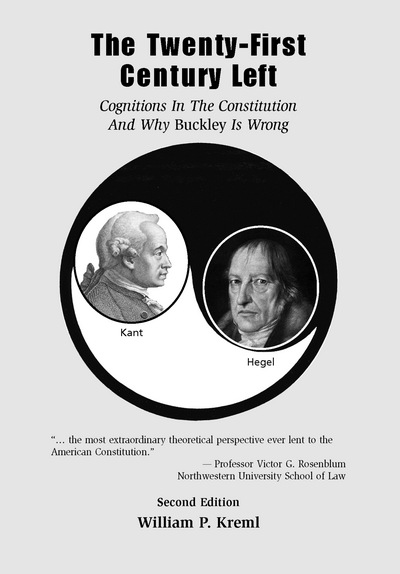
The Twenty-First Century Left
Cognitions in the Constitution and Why Buckley Is Wrong
Second Edition
2006
Tags: Constitutional Law
230 pp $30.00
ISBN 978-1-59460-251-1
The Twenty-First Century Left: Cognitions in the Constitution and Why Buckley Is Wrong applies the richest possible theoretical framework to the American Constitution. For the first time ever, a constitutional analysis focuses on the cognitive forms of the constitution's key provisions and the cognitive forms of key constitutional cases. Changes in cognitions, after all, are what herald appropriate changes in the law, changes that ensure justice by updating established legal principles.
William Kreml explores the cognitive, dialectical structure of the Earl Warren Supreme Court and its similarity to the cognitive structures of the English Edward Coke period. He examines the Constitution's primary debate—over the legitimacy of public encumbrances on private contracts—and reviews the cognitive similarity between Buckley v. Valeo (the case that denied campaign finance reform) and Dred Scott (the case that upheld slavery).
Further, Kreml analyzes the cognitively complementary nature of the Constitution's original seven articles and the Bill of Rights, noting the Bill of Rights' democratically aggregative purpose. Finally, he shows how Robert Bork and William Rehnquist misinterpreted Shelley v. Kraemer—the case that began America's Constitutional dialectic, and how John Hart Ely misunderstood the nature of the Warren Court.
"[T]he most extraordinary theoretical perspective ever lent to the American Constitution." — Professor Victor G. Rosenblum, Northwestern University School of Law
"The Twenty-First Century Left is a bold and, in many regards, impressive work. In striving to create a new theoretical map, Kreml sets out some novel ways in which we might rethink both our description and assessment of a wide range of political phenomena, including political behavior, jurisprudence, and the standards by which we evaluate our democratic vitality." — Law & Politics Book Review, March 2007