
This title has been replaced by a newer edition:
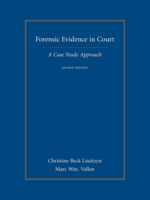
Forensic Evidence in Court: A Case Study Approach, Second Edition
2018, 476 pp, paper, ISBN 978-1-5310-0223-7
$58.00
Teacher's Manual available
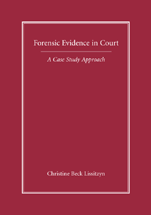
Forensic Evidence in Court
A Case Study Approach
2007
Tags: Courts; Evidence; Evidence; Forensics/Evidence; Law/Paralegal Studies; Legal Issues; and Paralegal
Teacher's Manual available
416 pp $47.00
ISBN 978-1-59460-370-9
eISBN 978-1-61163-462-4
Available in ebook and as print on demand via RedShelf
Forensic Evidence in Court covers the use of forensic evidence at trial through expert testimony as well as court challenges to many types of forensic evidence. The case study is the 1973 murder of Penney Serra in New Haven, Connecticut, which remained a cold case until 1997, when Ed Grant was identified based on a fingerprint match and subsequently convicted. The text examines forensic evidence in the Grant trial, including fingerprint, DNA, blood spatter, and eyewitness identification. It also examines trial strategy, handwriting testimony, polygraph, and exonerations based on newly-discovered DNA.
The book examines:
- What is circumstantial evidence? Is it as good as direct evidence? Why is forensic evidence circumstantial?
- What causes eyewitnesses to remember a particular face when later events prove that he is not the person they saw?
- Why does an appeals court allow an evidence ruling of a trial court to stand, even where the appeals court might have made a different decision?
- Do defendants have a Constitutional right to present certain evidence, such as polygraph, in their defense?
- How can the court determine if evidence is based on a reliable science that has been reliably applied?
This book can be used in courses for the following degrees: paralegal, criminal justice, sociology, and political science. Forensic Evidence in Court is also appropriate for use in a legal specialty course. Assignments include case law research, study of rules of evidence, how to select and prepare an expert witness, comparison of legal tests used to admit forensic evidence, study of standards used to review admission of forensic experts on appeal, and written work demonstrating critical analysis.
Any attorney can teach this course, using the Teacher's Manual and sample assignments. Adjuncts experienced in criminal law or extensive use of expert testimony are particularly well suited. Guest lecturers from state forensic laboratories and state law enforcement forensic investigators give added perspective.
The author teaches the course through distance education and can offer the course at your institution. She can be contacted at Lissitzyn@comcast.net.
"I am really impressed with this text. It is a brilliant piece of educational/legal writing" — Rex Gay, Portland State University
PowerPoint slides available upon adoption. To see sample slides from this 283-slide presentation, click here. Email bhall@cap-press.com for more information.