

This title has been replaced by a newer edition:
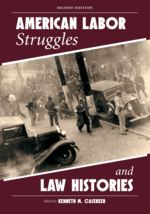
American Labor Struggles and Law Histories, Second Edition
2016, 638 pp, paper, ISBN 978-1-61163-872-1
$80.00
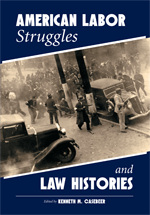
American Labor Struggles and Law Histories
Edited by: Kenneth M. Casebeer
2011
Tags: Labor/Employment Law and Legal History
486 pp $57.00
ISBN 978-1-59460-930-5
From slave rebellions, to the Lowell Mill girls, to Wisconsin and the Tea Party; this book tells the stories of law and legal action inevitably intersecting the collective actions of workers, in triumph or in anguish, over all of United States history.
Most people assume labor actions are carried out through trade unions and, therefore, that the relevant law of labor is the regulation of a particular form of collective bargaining between the representatives of workers (unions) and the representatives of owners (management). Neither assumption is accurate. It is striking to discover that most of the key labor struggles described in this book started either spontaneously among a group of workers, or at least began out in front of a sometimes unprepared or skeptical national union leadership that had to catch up to its members. Labor has at different times chosen strategies well beyond bargaining backed by strikes, including: consumer information (the union label); boycotts; picketing; small scale and ad hoc control over the tools, speed, and process of work; occupation of industrial plants; cooperative ownership; civil rights actions; independent and/or party politics; mass exodus; or even rebellion.
Not surprisingly, while sometimes invoked by labor as well as management, an amazing range of legal practices have been used by the State in the protection of employer interest and/or the repression of labor. Frequently, law appeared in protection and expansion of the common law prerogatives of property, antitrust legislation applied to unions but not to trusts, criminal and civil conspiracy convictions sustained by courts at all levels through sweeping injunctions prohibiting labor activity, and often use of militia or the U.S. Army explicitly to break strikes.
Importantly, entering law as an intervention in collective struggle inevitably requires a view of law from the bottom up. In contrast, entering law initially via Supreme Court opinions and other elite texts tends to record legal activity as winners-only history. Yet, as American Labor Struggles and Law Histories shows, law is always constructed as one arena of social struggle, channeled and shaped by both winners and losers. The deployment of power in our society has always altered our understandings of the possibility of democracy, particularly as American workers have fought to better their lives.
"...a collection of exemplary writings on law and labor relations that shows how judges and legislators have frustrated workers' organizations from the Colonial period to the present.…A timely volume for labor studies collections. Summing Up: Highly recommended. General readers; all levels of students; researchers and faculty." — CHOICE Magazine, R. L. Hogler, Colorado State University
"This is a book that we need now. When unions and the solidarity of working people seem to be at an especially low ebb, Ken Casebeer has come through with a book that reminds us that it has always been a long struggle and will continue to be. From slave insurrections to the recent events in Wisconsin, collective actions against injustice in working lives characterize American history. The stories are vivid, legal details are concrete, and the thematic quotes that accompany each chapter are inspirational. This is a past that we cannot afford to forget as we look at the future's choices." — Lea VanderVelde, Josephine Witte Professor of Law, University of Iowa College of Law
"This unique blend of legal case studies and gripping stories of collective action challenges narrow definitions both of labor law and of workers' agency. It takes on the fundamental problem of the relation between discourse and material conditions, text and context, law and society and offers a new way of seeing the interconnections between workers' consciousness and actions and legal practices. This wide-ranging anthology will be indispensable to law professors, historians, and, indeed, to anyone who sees the fate of working people and of American democracy as inextricably entwined." — Jacquelyn D. Hall, Spruill Professor of History, University of North Carolina at Chapel Hill, Director, Southern Oral History Program
"Editor Kenneth Casebeer has combined scholarly writings with contemporary accounts to produce a stirring, many-faceted examination of labor struggles in the United States over the past three centuries. Focusing on the intersection between legal regimes and workers' collective protests, American Labor Struggles draws upon both specialized historical and legal literature and vivid contemporary testimony. Beginning with Casebeer's own account of an early 18th-century slave revolt and concluding with an analysis of the militant activism of Chicago's Republic Doors and Windows workers in 2008, this important volume explores the reciprocal relationships between a wide variety of protest strategies, on the one hand, and an American legal regime that continues to privilege the claims of property over those of human values in the workplace. Of interest to legal scholars, historians, and labor activists, American Labor Struggles is a contribution both to scholarship and the ongoing quest for social justice in the United States." — Robert H. Zieger, Distinguished Professor of History, Emeritus, University of Florida
"American Labor Struggles and Law Histories is an indispensable compendium of excellent writing, critical to an understanding of the relationship between law and labor and the past and present. I recommend it for serious students of labor history and labor law." — William B. Gould IV, Charles A. Beardsley Professor of Law, Emeritus, Stanford Law School; Chairman of the National Labor Relations Board (1994–98)
"This is an exciting and, I believe, important collection. It transforms the field of 'labor law' from the dry study of technical rules governing state-supervised collective bargaining into the high drama of two centuries of—frequently very violent—labor conflict." — Robert W. Gordon, Professor of Law, Stanford University; Chancellor Kent Professor of Law and Legal History, Emeritus, Yale University